

There is a misconception lingering in the industry that the secret sauce of generative AI lies in the architecture. It doesn't. While predictive modeling and old-school deep learning were often battles of algorithmic optimization, the generative landscape is all about what the model consumes.
Today, industry research reveals that the world's leading AI teams spend more than eighty percent of their time strictly improving and curating training data. Because the system can only learn from what you show it. If the examples are thin, repetitive, biased, or low-quality, the outputs will be too.
If you want your system to solve problems rather than just repeat mistakes, you must master the art of the dataset.
How generative AI development works
Generative AI learns patterns from a lot of examples, then creates new text, images, video, or audio by predicting what should come next. It is generating something new based on what it learned.
Most successful teams follow a loop. Here’s a simplified version of the pipeline:
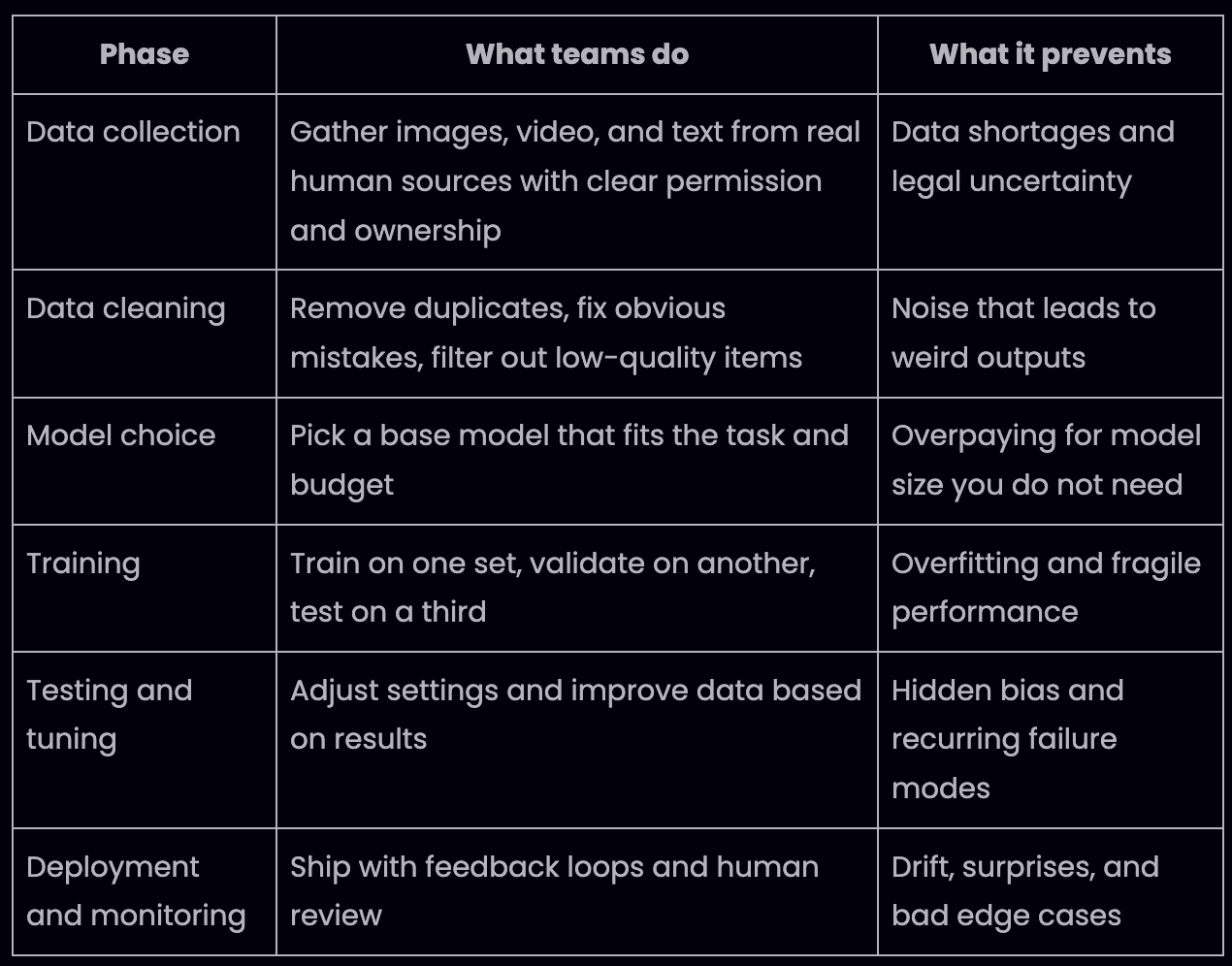
One thing to underline: if the early data stages are weak, the later stages cannot rescue you. You can tune forever. You will still ship a model that acts confident and wrong. Not ideal.
Human data vs synthetic data
A central strategic decision in modern AI development involves the precise balancing of human-generated data and machine-generated (synthetic) data. Human-generated data is content people create in real life, like photos, videos, books, support tickets, and forum posts. It tends to carry more context and nuance, including the weird edge cases that show up outside a lab.
Machine-generated data is created automatically by systems like sensors, software, or even other AI models.Synthetic data can be cheap and easy to scale, and it can help avoid some privacy issues. But it has limits. If you train a model too much on AI-made outputs, it can start copying its own mistakes.
Small errors build up, biases get worse, and the model slowly drifts away from how humans actually talk and behave. Synthetic data works best as a helper, filling specific gaps, while real human examples do most of the heavy lifting to keep the model grounded.
Smarter dataset construction
How do the pros actually teach these models to be smart? It requires incredibly specific AI best practices that go way beyond just dumping photos into a server.
The explanation turn
If an AI needs to do something complex, developers cannot just show it the answer; they have to explain the why. For example, instead of just telling an AI that the answer to a math problem is 4, the training data will include a written paragraph explaining exactly how the math works. This forces the AI to learn logic, not just memorize answers.
The power of negative examples
Interestingly, teaching an AI what not to do is just as important as teaching it what to do. A human will feed the AI a terrible, broken output, slap a big "NEGATIVE EXAMPLE" label on it, and explain exactly why it is awful. This establishes rigid boundaries and stops the AI from hallucinating when it gets confused.
The clean data rule
Beyond specific teaching tricks, the difference between a smart model and a dumb one usually comes down to data hygiene. You cannot simply hoard files; you have to scrub them. This means ruthlessly removing duplicates and junk.
If an AI sees the exact same photo or sentence too many times, it stops learning the concept and starts basically memorizing the answer key. We want the AI to understand what a cat looks like, rather than memorizing ten thousand specific pictures of the same tabby.
Testing for blind spots
Diversity is a strict safety requirement here. If your training data only represents one group of people or one specific style, the model will fail the moment it sees something new in the real world.
The pros use "adversarial testing" to fix this. Think of it as hiring a team specifically to try and break the model or confuse it. It is the only way to find those hidden blind spots before your customers do.
The Power of Curated Data
Your model’s success depends entirely on the quality of its training data. Raw, messy scraps from the web often confuse the system and lead to failure. You need organized, validated datasets that represent the real world accurately.
Teams that prioritize curation build reliable systems because the model learns from clear, correct patterns immediately.
Generative AI isn’t won by clever architecture alone. It’s won by building a data pipeline that can survive reality. That means collecting human-made examples with clear permission, cleaning aggressively, and filling blind spots before users find them for you.




Why does training data matter so much in generative AI?
What does curated data actually mean?
What are negative examples, and why do teams use them?
How do teams test whether a dataset is good enough to train on?
What’s the biggest mistake teams make when improving training data?