Remote graphic design jobs often mix very different opportunities together. Someone looking for a long-term position is different from a designer who wants several clients or a few recurring hours each week. Even within remote work, hiring processes can vary significantly.
This guide breaks down where different types of remote design work are actually found, what employers and clients are looking for in 2026, and how to build a portfolio around the work you want.
What Remote Graphic Design Work Looks Like in 2026
A search for graphic design jobs remote can surface positions that look similar at first but work very differently in practice. A role may be fully remote but limited to one country, require overlap with a specific timezone, or offer only a set number of hours each week.
It helps to separate that market into four broad work models:
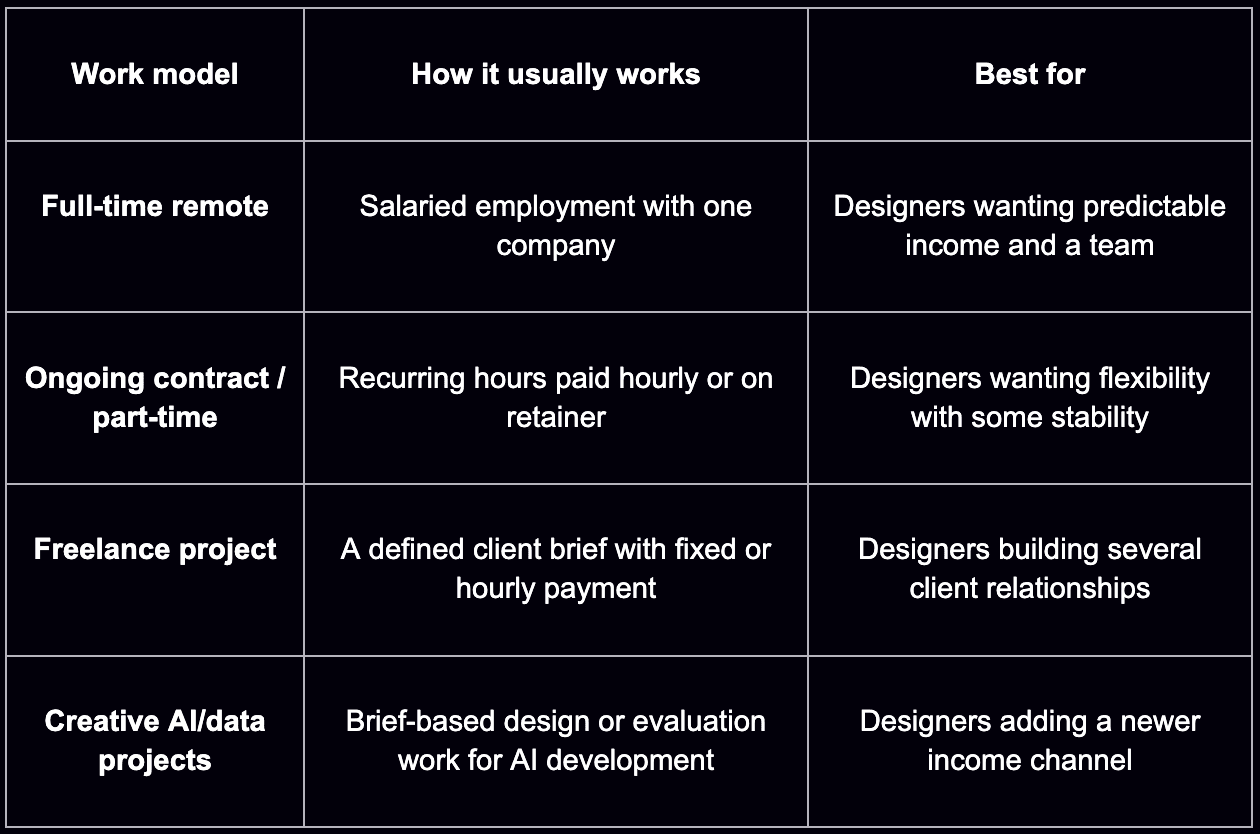
These categories can overlap, but the application process and portfolio expectations change with the work. AI development has also added another kind of project work. Wirestock’s library of graphic design datasets shows how assets such as infographics, editable brand kits, product mockups, and digital art can be structured for use in AI systems.
Where to Find Remote Graphic Design Jobs
The best place to search depends on the kind of working relationship you want. Broad job boards work well for permanent roles, while freelance platforms focus on individual clients and project scopes.
For Full-Time and Long-Term Remote Roles
LinkedIn is the broadest starting point for designers looking for employment with a company. Its remote searches include salaried and contract positions across experience levels, and alerts make it useful for following new openings without repeating the same search every day.
We Work Remotely is useful if working remotely is a priority rather than simply one filter among many. Its design listings include remote brand and UX/UI roles, with some positions open to applicants worldwide. Remote.co serves a similar purpose and also groups full-time, part-time, freelance, and work-from-anywhere opportunities.
Dribbble Jobs sits somewhere between the two. Designers can narrow listings by specialty, remote status, and employment type, which helps when you already know what job niche you're searching for.
For Freelance and Project-Based Design Work
Wirestock takes a different approach to freelance design work, connecting graphic designers, illustrators, and 3D artists directly with AI companies that need commissioned visual content or licensed design assets, rather than a general marketplace of business clients posting one-off briefs. Designers join a skill-based creator pool and can pick up paid, brief-driven projects from AI labs, or opt existing illustration and design work into a passive licensing program that pays out on an ongoing royalty basis.
This makes it a better fit for designers who want a steady stream of defined, spec-driven work than for those building a client roster or brand-facing portfolio. There's no client relationship or scope negotiation involved, the brief sets the terms, and payouts come through Wirestock's revenue share rather than an hourly or fixed project rate, so it tends to work best as a supplement to Upwork or Behance rather than a replacement for either.
Upwork offers one of the largest mixes of short assignments and longer clients posting freelance graphic design jobs. Designers can find fixed-price and hourly work covering anything from packaging and presentations to brand systems and ongoing production support.
A high rate does not tell you whether a project has a clear scope, a realistic workload, or a client worth working with. Proposal counts can also vary sharply between listings. Freelancers should evaluate the brief and client history before deciding where an application is worth the time.
Behance combines portfolio browsing with job listings, so employers can discover designers through their work as well as through applications. Its jobs area includes both freelance and full-time roles, and many freelance postings show project budget ranges. That can make it especially useful for designers who already maintain an active Behance portfolio.
For Part-Time and Recurring Contract Work
Some designers want more consistency without moving into a full-time position. For those searching for part-time graphic design jobs, recurring contracts can offer regular hours while leaving room for other clients or projects.
The useful signals are usually in the wording of the listing. Look for a stated weekly hour range or terms such as “ongoing,” “long-term,” and “contract-to-hire.”
Upwork regularly carries contracts structured around weekly commitments, including roles in the 8–10 or 10–20 hour range. Indeed also carries remote part-time and freelance design positions, making it worth checking alongside project-focused platforms.
Where Contest-Based Work Fits
DesignCrowd lets clients post design briefs that multiple designers can respond to. The client then selects the submission they want to use.
This kind of contest-based work is more speculative than an agreed freelance contract because submitting work does not guarantee payment. It may suit designers who are comfortable competing around open briefs, but it offers less predictable income than work secured with a client in advance.
How to Start Freelance Graphic Design Without Overcomplicating It
Starting freelance work does not require building an entire business before you have a client. Focus first on the work you want to get, make sure your portfolio supports it, and put a few basic systems in place for handling projects professionally.
Decide What You Want Your Portfolio to Get You
Start by thinking about what you actually want clients to hire you for. If you want packaging projects, your portfolio should make that clear. The same applies if you are aiming for brand work, presentation design, or social creative.
You do not need to choose one niche for the rest of your career. You do need enough focus that someone looking at your work can quickly understand where you fit. Designer Jessica Walsh has given similar advice: your portfolio should represent “the kind of work you want to be doing.”
Build a Portfolio Around Proof
A smaller portfolio of relevant work can say more than a large archive of unrelated projects. For each piece, give enough context to show what you were trying to solve and what part of the work was yours.
This is especially important when applying for a specific type of project. Clients are usually looking for evidence that you can handle work similar to their own brief, so lead with the examples that make that case strongest.
Set Up the Business Basics
Once you are ready to take on paid work, you need a simple process for agreeing on what you will deliver and how you will be paid. Define the scope, agree on a rate or project price, put the terms in a contract, and establish payment and invoicing expectations before starting.
You can add more business infrastructure as your freelance work grows. At the beginning, the priority is having enough structure to take on a client without confusion around payment.
Start With One Reliable Client-Acquisition Channel
You also do not need to promote yourself everywhere at once. Choose one channel that matches the work you want and learn how to use it well.
That might mean applying consistently through Upwork, building visibility on Behance, or using LinkedIn to connect with companies that regularly hire designers. Once one channel starts producing useful leads, you can decide whether adding another is worth the effort.
What Employers and Clients Actually Look for in Remote Designers
Strong design work is still the baseline, but current remote roles also show how much employers care about relevance and how well someone can work within an existing process. The strongest applications make both clear.
Your Portfolio Needs to Match the Work
Do not lead with the same projects for every application. If a role focuses on social design, show social work first. If the company wants someone who can work within an established brand, lead with a project that proves you have done that before.
Current listings frequently ask for specific examples rather than a general portfolio. The goal is to make the connection between your experience and the role easy to see.
Working Remotely Is Part of the Job
Remote employers are also hiring for how you work. Job descriptions regularly mention responsiveness, meeting deadlines, working independently, and collaborating with several stakeholders.
A designer may be expected to manage feedback without constant supervision or be available during set hours for team collaboration. Some remote positions also require overlap with a particular timezone, so location and working hours can still affect whether you qualify.
Adjacent Skills Can Widen the Work You Can Take
Adobe tools remain common across graphic design roles, while Figma appears frequently in digital work and Canva in fast-moving marketing teams. Motion, video, and experience with AI-enabled design workflows also appear as useful additions in current listings.
Can Remote Graphic Design Become a Full-Time Income?
Graphic design can support a full-time income, but freelance earnings are less predictable than employee salaries.
The latest U.S. Bureau of Labor Statistics data for graphic designers puts 2025 median pay at $62,960. That gives employed designers a useful national benchmark, but it should not be treated as typical freelance income.
Freelancers have a different calculation. Only part of their working time is billable, and income can change from month to month depending on how much work they secure. A higher hourly or project rate does not necessarily translate into a higher annual income if work is inconsistent.
Is AI Replacing Graphic Designers?
AI is reducing demand for some graphic design tasks, while changing the skills and roles companies hire for.
The Bureau of Labor Statistics expects graphic designer employment to fall from about 253,100 jobs in 2025 to 248,800 in 2035, a decline of roughly 1.7%. BLS specifically notes that AI and other automated design tools can increase productivity while reducing the number of workers needed.
The pressure is likely to be strongest on design work that can be produced quickly and repeatedly with automated tools. At the same time, current job listings increasingly pair traditional design skills with AI workflows. That puts more value on the parts of the job that involve judgment and understanding how a visual system should work.
For designers, the practical response is to learn where these tools fit into an existing creative process. Knowing how to use AI can expand the work you can take on, but the stronger differentiator remains knowing when an automated result is not good enough.
AI Training Is Also Creating New Work for Designers
AI is also creating a new category of design work around training and evaluating visual models. Current remote listings include roles for graphic designers who review AI-generated output, assess visual quality, or contribute design expertise to model development projects.
The work can look different from a typical client brief because AI teams often need to see how a design is built. For example, an editable brand kit or product mockup preserves the structure behind the final design. Source formats like Figma or PSD can be useful for this kind of work.
Wirestock connects designers with this kind of project-based work through its creator network. Designers can apply to Wirestock’s graphic design creator pool and may be contacted when a project matches their skills and style.
AI training can give designers another income stream alongside freelance clients or full-time work. Projects can be taken on when suitable briefs become available.
Where to Find Remote Graphic Design Work at Your Experience Level
Remote hiring currently skews toward experienced designers. LinkedIn’s design results show mid to senior roles, and remote-first boards such as We Work Remotely also list more senior and specialist positions than junior openings.
If you're early in your career and looking for remote graphic design jobs, start with the right platforms.
Entry-Level Designers
Start with LinkedIn and Indeed, where employers advertise assistant, junior, and early career positions within established teams. Those roles can give experience working under a design lead, responding to internal feedback, and producing work inside an existing brand system.
Be prepared for entry-level to still mean some experience. Current junior remote listings ask for two or more years of professional work.
Upwork can help fill that gap, but choose projects carefully. Current entry-level listings include ongoing and contract work to gain experience alongside poorly paid jobs with a surprising amount of output. Use it to build stronger proof of work.
Mid-Level Designers
With a few years of work behind you, the search can become more specific. LinkedIn is still useful for in-house roles, while Behance and Upwork become stronger options once you can show relevant client or commercial work
At this stage, AI projects can also complement freelance or salaried work. Wirestock can be useful for designers whose existing skills match project briefs involving visual creation or evaluation for AI development.
Senior and Experienced Designers
At senior level, focus on platforms that list specialist roles. Dribbble has senior graphic and visual design jobs, while We Work Remotely lists staff, senior, and lead roles from remote-first companies.
Senior designers can also bring deeper judgment and domain experience to AI projects. Through Wirestock, that can mean contributing to briefs where established design expertise is especially useful for creating or evaluating visual material.
Conclusion
When looking for remote graphic design jobs, start with the kind of work you actually want. Then focus your search on the platforms where that work appears and lead with portfolio pieces that make your fit obvious.
If you want to add AI-related project work to that mix, you can also explore Wirestock’s opportunities for creators. New types of design work are emerging alongside traditional freelance and in-house roles, giving designers more ways to build a remote career around their skills.

Can graphic designers work remotely?
Is AI replacing graphic designers?
Can you live off of being a graphic designer?
Are graphic designers still in demand?
Do you need a degree to get a remote graphic design job?
How can you tell if a remote graphic design job is legitimate?