

If you stripped a Large Language Model (LLM) or a diffusion model of its algorithmic architecture, what remains is arguably more valuable: the library of experiences it has consumed. This called AI training data, and it could make or break whether your model is useful in the real world.
What is AI training data?
It’s the collection of inputs, examples, and feedback that a model ingests to learn patterns and behaviors. For generative AI, that means:
The text corpora that shape how an LLM writes, reasons, and follows instructions.
The image–text pairs that teach a model how style, objects, and composition relate.
The human feedback that steers a model away from harmful or low-quality outputs.
Inside an AI Training Dataset
An AI training dataset is made up of individual data points. Each one typically has:
Features / Inputs – The signals the model sees.
For a credit risk model: salary, employment history, existing debt.
For an LLM: tokens (pieces of words), their order, and surrounding context.
For an image model: pixel values plus any paired text, captions, or attributes.
Labels / Targets (in supervised learning) – The “answer” you want the model to learn.
For image classification:
cat,dog,car.For sentiment analysis:
positive,neutral,negative.For safety classifiers:
allowed,unsafe,needs review.
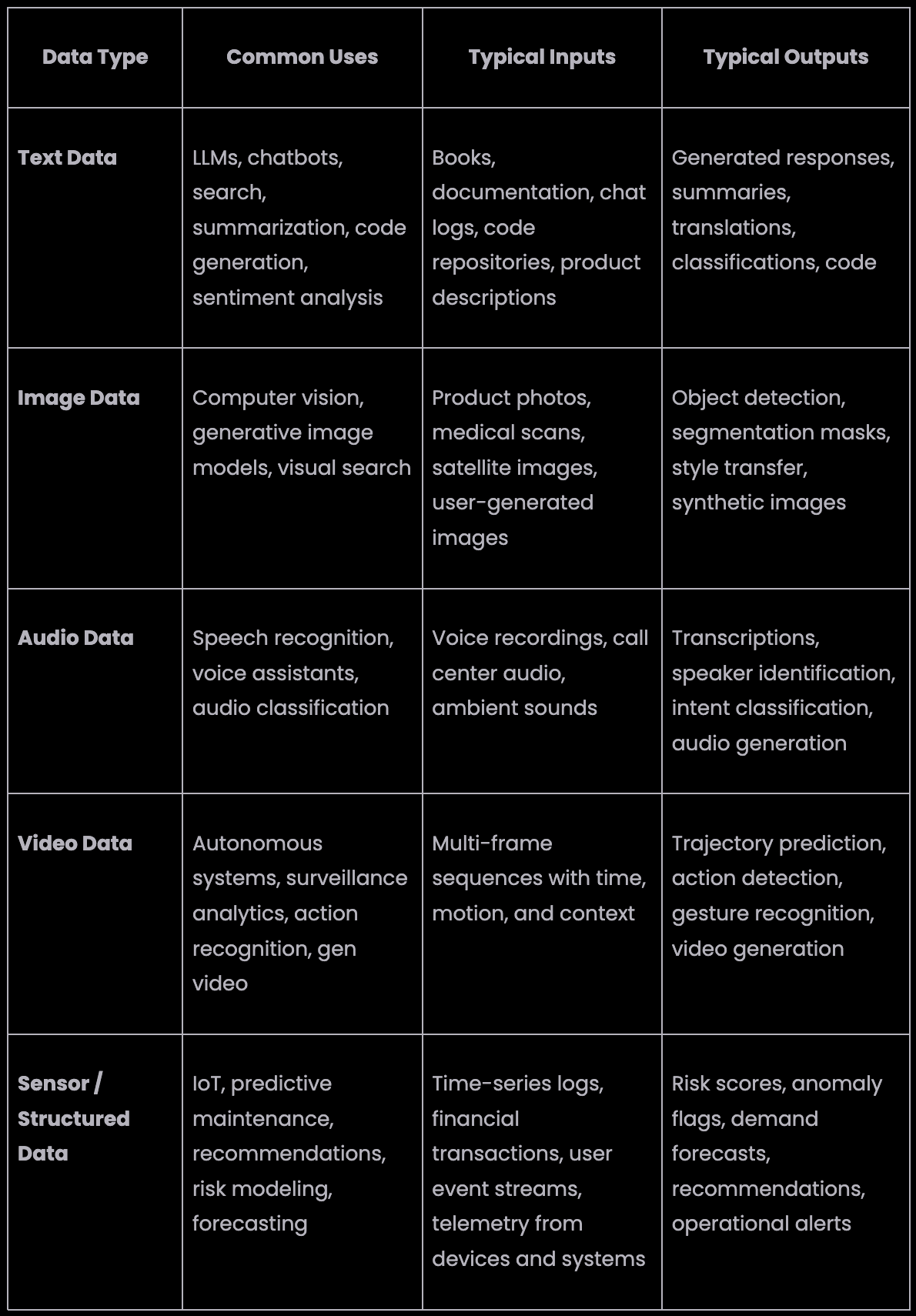
Unlocking Complexity with Multimodal Data
In the table above, each data type sits on its own. In practice, the real leverage for modern AI companies is where these formats meet. That layer is multimodal data.
Multimodal data meaning is the shared understanding a model develops when it sees different data types together and aligned in context. Instead of learning from text or images separately, the model learns how they relate.
Picture a single training example composed of three aligned signals: an image of a golden retriever on a red velvet sofa, a caption that reads The friendly golden retriever on the red velvet sofa, and an audio clip with a bark and low living-room background noise.
During training, a multimodal model is optimized so that all three inputs map into a shared representation space. In that space, the visual pattern of the dog is pulled toward the tokens golden and retriever, the color and texture of the sofa are pulled toward red velvet sofa, and the audio pattern of the bark is pulled toward the same underlying concept of dog in a living room.
The Three Pillars: How Learning Paradigms Shape Your Data Strategy
From a company perspective, you don’t need to necessarily design model architectures, but you need to understand how they learn from your data. In practice, most production systems lean on three main paradigms.
Supervised Learning: When the Outcome Is Clear
Supervised learning is the most familiar pattern for business teams. You have inputs and you know the outcome you care about, so you turn that into labeled examples.
In practice, this covers things like spam vs. not spam, “refund / no refund,” safe vs. unsafe content. In generative AI, supervised data is used to train and fine-tune:
Content filters and safety classifiers
Domain-specific variants of LLMs (e.g., legal, medical, financial)
Rankers that pick the best answer, image, or completion for a user
Operationally, supervised learning means you need clear label definitions, annotation guidelines people can follow consistently, and enough examples per class for the model to behave reliably.
Unsupervised and Self-Supervised Learning: Putting Raw Data to Work
Unsupervised and self-supervised methods extract structure from data you haven’t labeled by hand. This is how most large foundation models are pre-trained: they learn from raw text, images, and video at scale.
f you feed models customer conversations, internal documentation, product imagery, or usage logs, unsupervised training can:
Discover patterns and segments in your user base
Learn general language and visual representations you later adapt to your domain
Reduce the volume of manual labeling required downstream
You’re not tuning the algorithms, but you are curating which raw corpora are in scope and what gets filtered out.
Reinforcement Learning and RLHF: Learning from Consequences and Preferences
Reinforcement learning (RL) introduces feedback from consequences. The model learns by trying actions and receiving rewards or penalties.
In generative AI, the most relevant version is Reinforcement Learning with Human Feedback (RLHF). Instead of training only on static labels, the model is tuned on judgments like answer A is more helpful than answer B. Over time, it internalizes those preferences.
From an organizational standpoint, RLHF is mostly about building a feedback pipeline:
Deciding who is qualified to rate outputs for quality, safety, and brand fit
Capturing those preferences at scale with clear, consistent instructions
Refreshing that feedback as your product, policies, and markets evolve
Building a Production-Ready Training Data Pipeline
Before any model is trained, training data for AI has to move from its original sources into a form that’s actually usable. The training data pipeline is that path end to end: how data flows through your systems, your tools, and any external providers until it’s ready for training and evaluation.
1. Data Collection: Assembling the Raw Material
Collection is about deciding which sources feed your models. It sets the baseline for what the system can understand on day one, even though reinforcement learning and live usage will add more signal later.
Typical sources include:
Your own products and systems: support conversations, CRM events, user actions, product images and videos
Public and open datasets, after licensing and compliance checks
Licensed content and data partnerships
Specialist providers offering curated, domain-specific or multimodal datasets
If key markets, languages, formats, or edge cases are missing here, they tend to show up later as brittle behavior or silent failures. Collection is where you make sure the right raw material is even in scope.
2. Data Cleaning and Transformation: Making Data Trainable
Most collected data is inconsistent when it first lands: different schemas, different quality levels, and a lot of noise.
Common problems:
Duplicate or near-duplicate records
Corrupted files or partial logs
Missing fields, mismatched schemas, odd encodings
Toxic, off-topic, or obviously low-quality content
Cleaning and transformation is where you or your data partners:
Remove duplicates and normalize obvious inconsistencies
Standardize formats and units so downstream work isn’t spent on one-off fixes
Filter or down-weight content that clearly shouldn’t shape model behavior
Turn raw inputs into the fields or features your modeling stack expects
This step shapes how often the model hallucinates, how stable its tone feels, and how much extra work you need from safety filters later
3. Data Annotation and Human-in-the-Loop: Adding Judgment
Annotation is where human judgment enters the pipeline and raw data turns into labeled examples or preference signals.
In practice, this can involve:
Drawing boxes or masks around objects in images and video
Tagging text for sentiment, topic, intent, or policy violations
Rating model outputs for helpfulness, correctness, safety, or brand alignment
Marking events and actions across a video timeline or user journey
This work might be done in-house, with external providers, or both. What matters is that the process is structured.
A solid human-in-the-loop setup gives you:
Ground-truth labels for supervised tasks
Preference data for methods like RLHF, where models learn from “better vs. worse” choices
A steady stream of edge cases that helps refine label definitions, policy rules, and guidelines over time
For most organizations using AI training data sets, this should be an ongoing operation rather than a one-time push for labeling.
4. Evaluation and Refresh: Keeping Pace with Reality
Once a model ships, the pipeline doesn’t stop; it shifts into maintenance and improvement mode.
You typically need:
Stable evaluation sets (“golden datasets”) that don’t change, so you can compare model versions on the same benchmarks
Fresh data to capture new behaviors, vocabulary, products, and regulatory requirements
Feedback loops that pull production signals like user ratings and reviews back into annotation and, eventually, back into training
In the end, architectures and APIs will keep changing, but your training data for machine learning is what everything rests on. How you source, clean, label, and refresh that data decides whether a model becomes a dependable product or just a flashy demo.
If you invest in that pipeline, internally or with the right partners, every new model you plug in has a far better chance of working for your use case on day one.For teams building multimodal systems, Wirestock provides fully licensed image and audio content plus production-grade video datasets for machine learning.

Where can I train an AI model?
Is AI training data fair use?
How much does it cost to train AI models?
What are the four types of AI models?